
What Is the Difference Between a Single-Arm and a Dual-Arm Lab Robot?
With two arms, one arm can do the next task while the other holds a tube, which cuts the steps of putting it down and picking it up again. This post compares the single-arm uLab Uno (up to 90 tubes per hour) and the dual-arm uLab Duo (up to 170) using official specifications, and covers how to choose.
With two arms, you can "do another task while holding on." A single arm sometimes has to put a tube down and then make the next motion. With two arms, while one arm holds the tube, the other handles the cap or picks up the next tube. That cuts the intermediate put-down and waiting steps.
The comparison below is based on the official material and our product pages for the uLab Uno (single arm) and uLab Duo (dual arm) from United Robotics Group, which we supply.
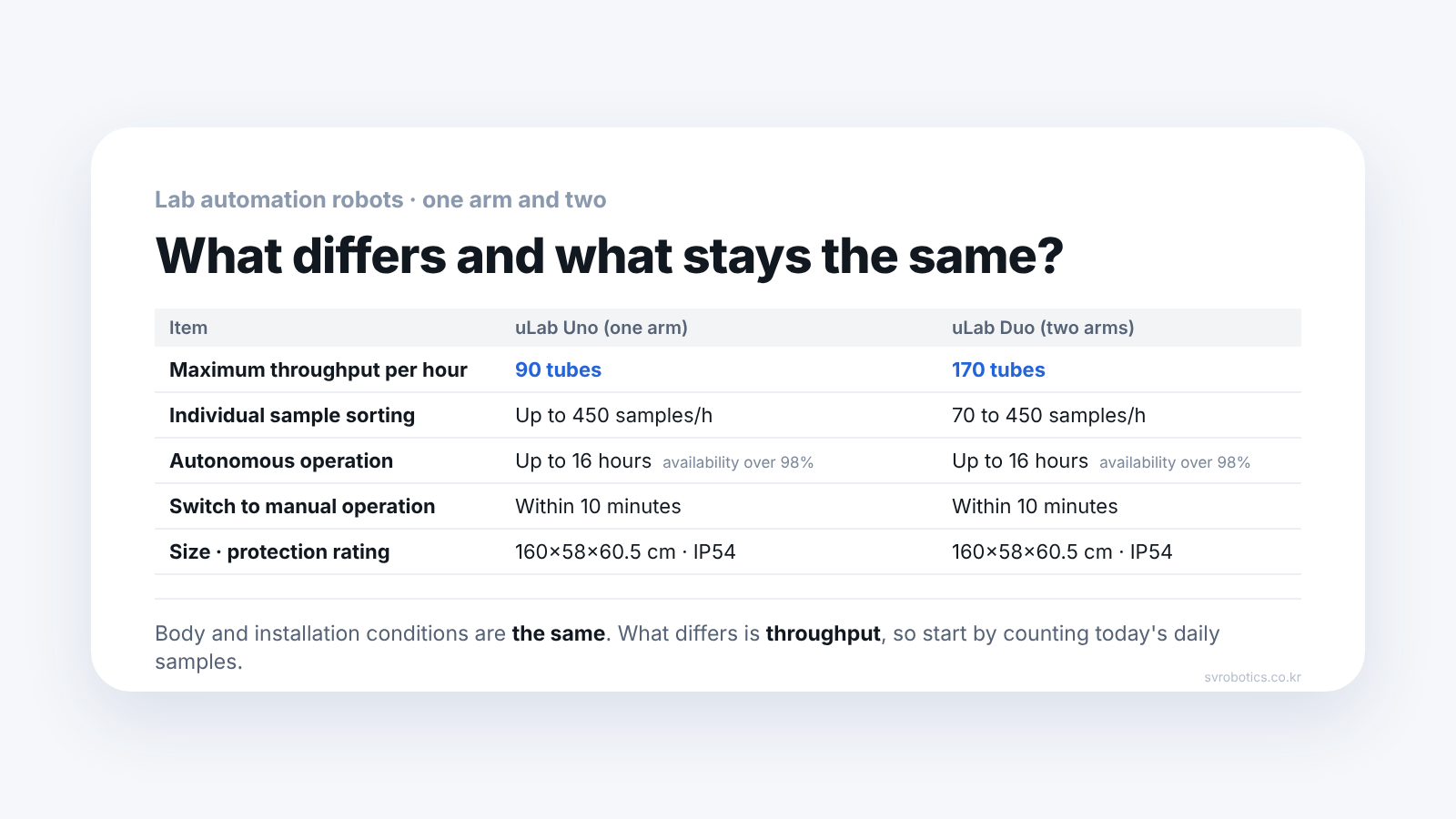
How different are they in numbers?
| Item | uLab Uno | uLab Duo |
|---|---|---|
| Robot arms | 1 | 2 collaborative robot arms (each with a 2-finger gripper, 50 mm stroke) |
| Maximum throughput per hour | 90 tubes | 170 tubes |
| Individual sample separation | Up to 450 samples/h | 70 to 450 samples/h |
| Autonomous operation | Up to 16 hours | Up to 16 hours |
| Availability in autonomous operation | Over 98% | Over 98% |
| Switch to manual operation | Within 10 minutes | Within 10 minutes |
| Work management | uGo+ | uGo+ |
| LIS connection | CLSI LIS1-A + REST API | CLSI LIS1-A + REST API |
| Acquisition | Purchase or RaaS | Purchase or RaaS |
Throughput depends on test conditions and how samples are run. The two products use the same management software (uGo+) and the same adoption process (technical review, phased transition, handover, autonomous operation).
Do they differ in size and installation conditions?
In the official specification table, the body size and installation conditions were the same for both products. Even with a different number of arms, they fit in the same size of bench-type body.
| Item | Common specification for uLab Uno and uLab Duo |
|---|---|
| Size | 160 × 58 × 60.5 cm |
| Weight | 100 kg |
| Maximum payload | 5 kg |
| Working radius | 800 mm |
| Protection rating | IP54 |
| Cleanroom class | ISO 14644-1 Class 6 |
| Power consumption in normal operation | About 200 W |
| Power / network (additional configuration) | 10 × 230V / 16A · 7 ports |
When looking at the installation spot, add the space for people to walk and the positions of the instruments to connect to this size. The power condition in the specification table is 230V/16A.
Which steps become easier with two arms?
Steps that need two hands.
- Sorting and preparation in sequence. One arm picks while the other arranges the sorting position
- Centrifuge loading and unloading. The put-in and take-out motions continue without a pause
- Next handling while holding a tube. It reduces the intermediate put-down that a single arm needs
A single arm can do the same work, but a step of putting the tube down is inserted between motions. You can take that difference to appear as the difference in hourly throughput.
What features do both products share?
The way they recognize and verify tubes is the same.
- AI tube recognition. It tells specimens apart by looking at tube shape and cap color (cap color recognition rate of 95% or higher, containers conforming to EN 14820 / ISO 6710)
- Barcode verification. It reads barcodes of 8 to 20 digits and sends the tube to the next task
- Installation in an existing lab. It is placed next to the benches and instruments you use now, without major structural changes
- Safety functions for working with people. Certified safety zone and 17 configurable safety functions, safety performance PLd, Category 3
- Operation without a constant internet connection. The Uno processes operating data on the device, and the Duo processes it in the lab's internal systems and can also use a closed lab network, as described
So the difference is not in "what they recognize" but in "how many motions they can chain at once." If your concern is breaks in the processing flow rather than the accuracy of recognizing specimens, look at the number of arms. If reducing one repeated task comes first, start with the single arm.
Which one is right for our lab?
Choose by daily specimen volume and the complexity of the steps.
- You want to cut the repetition of one step first, and specimen volume is moderate → uLab Uno. It is a good place to start with one task, such as centrifuge loading and retrieval
- A hospital or clinical lab with high specimen volume, or long preparation steps that need two hands → uLab Duo
- Work has to move between benches → look at the mobile uLab Mobile instead of two fixed units
Both products use the same management software, uGo+.
What should you prepare before a consultation?
- Daily specimen count and the busy hours
- The sequence of motions people perform now. Picking up, reading barcodes, caps, centrifuging, the next instrument
- The list of instruments to connect
- Whether you use a LIS. If you do, CLSI LIS1-A or REST API. If not, routes are set in uGo+ by barcode suffix, cap color or manual assignment. SiLA is in preparation, and OPC UA is applied project by project
- Overnight operation plans
Frequently asked questions
With dual arms, are people not needed at all?
It runs up to 16 hours without supervision on the premise of a defined work sequence and stable instrument connections, but the lab team checks operating status and handles exceptions through uGo+. When needed, it can be switched to manual operation within 10 minutes.
Does it have to be connected to the internet?
Both products are described as able to run without a constant internet connection. The Duo material states that a closed lab network can also be used and that the customer decides whether operating data is stored, analyzed or deleted.
Is it all right to use it in the same space as people?
Both products support a certified safety zone and 17 configurable safety functions, and safety performance is at Performance Level PLd, Category 3. For the Duo, conformity with 2014/35/EU and 2014/30/EU is also stated in the specification table.
More detail: uLab Duo product page · uLab Uno product page
The figures here are based on United Robotics Group's official material and the SV Robotics product pages. Price and installation time depend on lab conditions, so they are not given.
Pre-adoption checklist: What Should You Check Before Adopting Lab Automation Equipment?
Next step
Tell us the daily specimen count and the busiest time of day, and we will look together at whether one arm or two fits. Prices are given as a separate quote depending on configuration.