
My Analysis Instruments Are Automatic, but People Do the Work Between Them. Can a Mobile Lab Robot Take That Over?
The target is the repeated work between instruments, such as loading and unloading samples, removing tube caps, cold storage retrieval and moving racks. Using the mobile robot uLab Mobile as an example, this post covers a configuration of daytime collaboration and overnight autonomous operation, and what to check before adoption.
Yes. The repeated work of moving between instruments and putting samples in, taking them out and carrying them is the job of a mobile lab robot. If the analysis instruments themselves are already automatic and people are filling the gaps between them, it is worth considering.
uLab Mobile from United Robotics Group, which we supply, is a mobile manipulator: a robot arm mounted on a body that moves by itself. What follows is based on the manufacturer's official material and our product page.
Why is the work between instruments a problem?
Because instruments wait for the next sample while skilled staff spend time on carrying and loading.
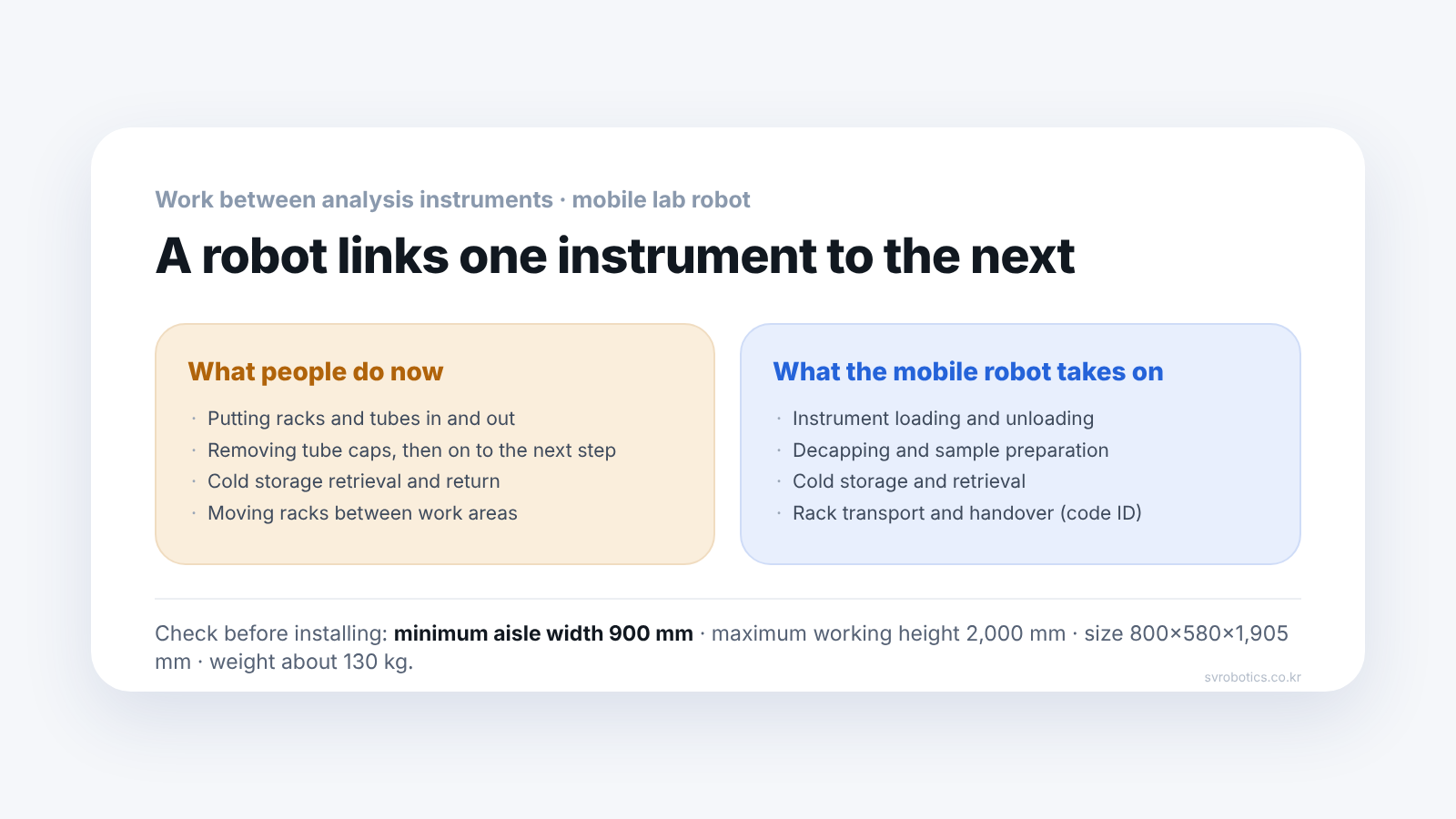
- Repeated manual work. Removing tube caps, loading centrifuges and analysis instruments, and retrieving cold-stored samples repeat many times a day
- Instrument idle time. Instruments sit stopped while people do other things
- Night and weekend gaps. When working hours end, the flow stops too
- Specialist time. It goes to carrying instead of analysis and judgment
What work can the robot take on?
It falls into five kinds.
| Task | What it does |
|---|---|
| Instrument loading and unloading | Puts racks or individual tubes into an instrument and retrieves finished samples |
| Decapping and sample preparation | Removes tube caps, divides tubes into set positions and passes them to the next step |
| Cold storage and retrieval | Takes racks out of a cold storage unit and stores finished samples again |
| Rack transfer and handover | Moves racks between work zones using sensor alignment and code identification |
| Instrument integration | Connects to existing instruments through standard API and MQTT |
The key point is that it is designed to work alongside people at existing bench height. Instead of building a new fixed automation line, the direction is to use your current routes and instruments as they are.
Can it work alone at night?
A configuration that mixes daytime collaboration with overnight and weekend autonomous operation is possible. During the day it works beside staff, and during unattended hours it carries out only verified work sequences by itself.
A case at an overseas medical testing organization published by the manufacturer also describes hybrid operation: collaborating with lab staff during the day and carrying out work sequences autonomously at night. The important word here is "verified." Only work that has been run enough in front of people during the day is handed over at night.
Who sets up the work sequence?
You set it up in the management software uGo+ without coding. You configure the robot's tasks by defining work sequences, the spatial map, priorities and operating rules. It is the same uGo+ used with uLab Uno.
How do you choose between it and the single-arm uLab Uno?
Uno for repetition at one spot, Mobile when it has to move between several spots.
- uLab Uno. A fixed single robot arm that handles tubes at one bench or around a specific instrument
- uLab Mobile. A mobile type that moves by itself between several work points and instruments, doing transport and work together
How to start from one step is covered separately in the post "Moving Sample Tubes in the Lab: Where Should Robot Automation Start?"
What are its size and specifications?
It is about the size of a person, and it needs an aisle of at least 90 cm. The table below is based on the official technical material from United Robotics Group.
| Item | Official specification |
|---|---|
| Size (length × width × height) | 800 × 580 × 1,905 mm |
| Weight | About 130 kg (depends on configuration) |
| Minimum aisle width | 900 mm |
| Maximum working height | 2,000 mm |
| Height from floor to body | 25 to 28 mm |
| Top speed | 2.0 m/s |
| Battery operation | About 5 to 6 hours (a 24-hour configuration is possible with charging during work) |
| Instrument integration cases | 30 or more, including clinical chemistry, hematology and specimen transport (TLA/TTA) |
| Safety and conformity | Conformity relating to CE (Machinery Directive 2006/42/EC), ISO 3691-4 and ISO 13482 is stated |
Because the height from floor to body is 25 to 28 mm, thresholds or floor joints higher than this may be hard to cross. 900 mm is the minimum aisle width, and in practice you also need to look at turning space and access room in front of instruments.
What do you check before adoption?
- The route it travels. Whether the narrowest aisle between benches is 900 mm or more, the height of thresholds and floor joints, doors and elevators
- The containers and racks it will handle
- The instruments to connect. Whether API or MQTT integration is possible
- The structure of the cold storage unit. Whether it is a form from which the robot arm can take racks
- The list of work to hand over at night. The sequences to verify during the day first
Frequently asked questions
What kinds of organizations use it?
The main targets are research and quality departments of biotech and pharmaceutical companies, public research and testing institutes, university labs and shared equipment centers, and hospital diagnostic labs.
Do I need to know how to code?
The work flow is set up in uGo+ without coding. The scope of instrument integration is reviewed separately for each site.
Is it all right to work in the same space as people?
It is designed to work with people at existing bench height, and it recognizes people and obstacles and slows down in crowded places. The official technical material states conformity relating to CE and ISO 3691-4 and ISO 13482. Actual zone settings are confirmed together during the site review.
Where do test results and sample information end up?
The manufacturer explains that uLab Mobile connects to the laboratory information system to record results and sample settings, and can communicate with instruments through API and MQTT. The scope of integration needs to be checked against the institution's LIMS and the instrument specifications.
More detail: uLab Mobile product page · uLab Uno product page
The content here is based on United Robotics Group's official material and the SV Robotics uLab Mobile product page. Throughput, price and installation time depend on site conditions, so they are not given.
Pre-adoption checklist: What Should You Check Before Adopting Lab Automation Equipment?
Next step
Tell us the aisle width, the instrument layout and the number of racks that move per day, and we will point out the sections a mobile robot can take on first. Prices are given as a separate quote.