
What Is Reinforcement Learning, and How Does a Robot Learn to Walk by Itself?
There is a method where you do not teach a robot "walk like this" step by step. It tries things and gets scored, and that alone lets it find how to walk on its own. We explain reinforcement learning with an easy analogy, leading into the result of applying it to our K1 robot.
We do not teach a robot "walk like this" one step at a time. Instead, we give it a score when it does well, and let the robot find the method itself by looking at that score. This approach is called reinforcement learning.
With this method, we trained a real humanoid robot, Booster K1, to walk inside a simulation. This article explains the principle so that you can understand it without a technical background.
Is it like training a dog?
Instead of explaining "sit" in words, picture giving a treat each time the dog sits. The dog does not understand why it should sit, but it comes to do more and more often the action that earns it more treats (rewards).
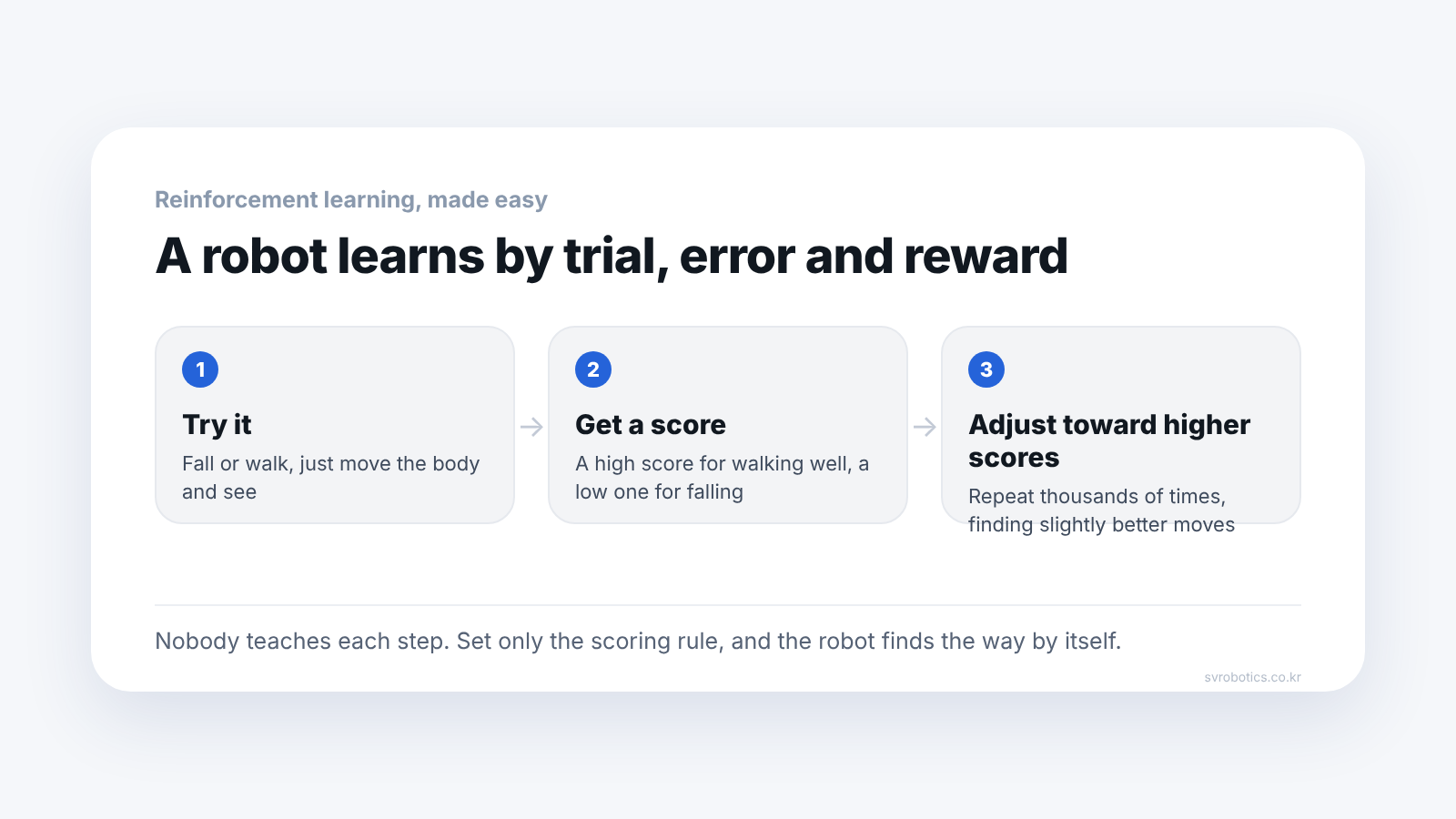
Reinforcement learning works on the same principle. Instead of teaching the robot every motion, such as "bend the leg like this and straighten it like that," we only set the standard for giving a score (reward) for walking well, and let the robot find, after a great many attempts, the direction in which the score goes up.
What are the three repeating steps?
Try it → get a score → adjust a little toward the higher score. Repeating these three steps a great many times is all there is to it.
- Try it — At first it moves its body randomly. Most of the time it falls
- Get a score — A score is given according to whether it stayed standing for long, moved forward, or fell
- Adjust toward the higher score — The way of the attempts that scored even a little higher is reflected more in the next attempts
When we trained the K1 robot, we repeated these three steps thousands of times inside a computer with 4,096 robots at once. It is a speed that would have been impossible if a person had taught them one by one.
Why do it inside a simulation?
Because you cannot knock a real robot down thousands of times while it tries. Parts get damaged each time it falls, and it also takes a long time. A virtual robot inside a computer does not get hurt when it falls, and by running many at once you can make thousands of attempts in a short time.
We built a virtual model of Booster K1 on a simulator called Isaac Sim and trained it this way. On a PC with a single GPU, we were able to produce a robot that walks without falling in 32 minutes.
Why does "how the score standard is set" matter so much?
Because if the score standard is odd, the robot finds an odd method too. The score standard we first made was "points for moving forward without falling," and as a result the robot walked with a shuffle of more than 15 foot steps per second. The score standard had no item for the shape of the gait.
When we reset the standard to also give points for gait shape, the gait changed to one closer to a human's, with 3 to 4 steps per second. The hardest job in reinforcement learning is not moving the robot, but building the score standard well, deciding "what counts as doing well."
Frequently asked questions
Does the robot think for itself and walk?
No. A robot does not "think." As a result of a great many attempts and scores, the way it computes is only adjusted so that it picks the motion patterns that scored higher more often.
Is there nothing for people to do?
There is. Deciding how many points to give for which behavior (designing the score standard) is done by people. How you build this standard changes the result a great deal.
If it walks well in simulation, will it walk right away on a real robot?
It is not guaranteed. Simulation and real physics differ, so you need a step of moving it to another simulator or checking it again on a real robot. We confirmed this part too, in other articles of our series.
Do you need expensive equipment for this kind of training?
We did it on one ordinary PC with a single GPU. The detailed specs and the time it took are collected in the series below.
Next step
The whole process of applying this principle to the real humanoid robot K1 — from installation to the first training, improving the gait shape, and checking in another simulator — is published as it was in our series "Physical AI, Hands On."
Source: Our K1 walking reinforcement learning series (2026-09-10 to 23). The analogies and explanations are meant to aid understanding; the exact figures and procedures are in each article of the series.
The copyright of this article and its figures belongs to SV Robotics. Quotations that credit a link to the original are welcome; reproducing or redistributing the full text, or reposting it as teaching material, requires permission.