
We Gave a Virtual K1 a Museum Guide Job — Running the Course on a Learned Gait, and Not Trusting a Number That Came Out Well Once
We attached Booster K1's reinforcement-learned gait to a museum guide simulation. Reading markers, walking up to each exhibit and giving a talk, three gaits trained from different seeds each ran the course and all reached the exit, with no falls. All of it is simulation, and whether the gait is good enough is judged separately, by the average and worst value over several trainings with different seeds.
Every number in this article comes from simulation. We have not yet put this on a physical K1.
We attached a gait learned by reinforcement learning to a museum guide job. In a course where the virtual K1 reads markers on the floor and walls, walks up to each exhibit, gives a talk and leaves by the exit, with visitor models moving around, all three gaits trained from different start numbers (seeds) finished without a fall (simulation). The first two attempts did not complete the course, and we also record how we separated the causes and fixed them.
In Part 3 of the series, we moved the gait learned in Isaac Lab to another simulator (MuJoCo) and checked it again. This part is the story of attaching that gait to a job closer to real use.
What did we simulate?
This is the virtual exhibition room seen from above. There is a stop point in front of each of three exhibits, and a marker near the exit.
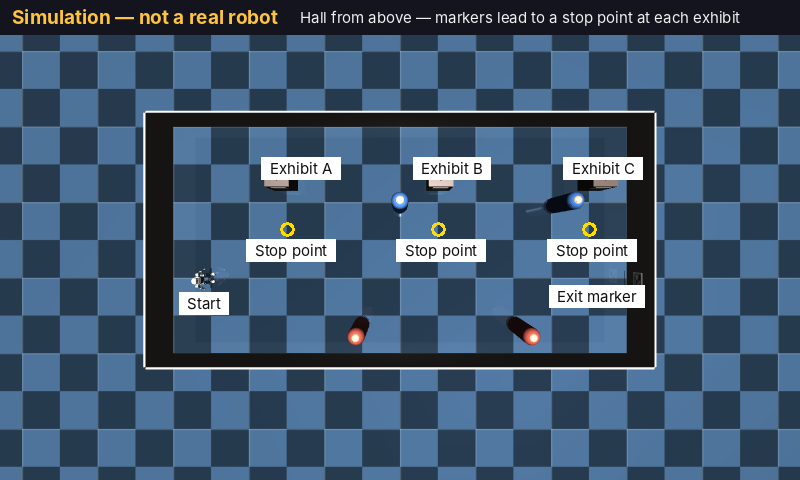
This is what K1 does.
- It looks at the markers (AprilTag) on the floor and walls with its head camera and corrects its own position.
- It walks to the stop point in front of the next exhibit and stands there.
- It gives a talk about the exhibit (30 seconds at each one in this simulation).
- After the three exhibits, it goes to the exit marker.
- If a person comes within 1m ahead, it stops.
- If a person is blocking the front of an exhibit, it waits and asks them to step aside. If it is still blocked, it gives the talk from a spot a little way off. If it keeps being blocked, it skips that exhibit and goes on to the next (simulation).
For the walking motion we used, as it was, the gait we trained with reinforcement learning. Where to go and when to stop are decided by a guide program that people wrote. The structure is learning for walking, rules for route-finding and stopping.
How did it turn out?
Below are the results of running the course with all three gaits trained from different start numbers (seeds), using the gait with corrected settings so that it passes the judgment described later (simulation).
| Item | Result (simulation, three gaits) |
|---|---|
| Course completion | For all three gaits, 30 laps each, with and without visitors, and every lap reached the exit. In some laps the front of an exhibit stayed blocked and one exhibit was skipped |
| Falls | 0 for all three gaits |
| Stopping for a person within 1m ahead | Stopped every time in the 180 tests (three gaits × 60) where we deliberately sent a person into it, and across the whole course |
| Position in front of an exhibit | Off the target spot by a little over 10cm on average, and within 30cm even in the worst case |
| One lap | About 3 minutes if it visits all three talks (around 3 and a half minutes with many visitors) |
An average alone hides some values, so we also give the worst case.
Did it work from the start?
No. At first we ran the course with the gait before the settings were corrected. We ran it three times with the same scene and the same conditions, and only on the third run did every lap finish.
- First run: it failed many times in the person-stopping test. The cause was not the robot but the test program. The test thought it had moved the robot to the start spot, but the robot, moving with the learned gait, had stayed at the start point. The test was run with the person and robot positions out of sync.
- Second run: the person-stopping test passed, but some laps did not finish. The failures all came in the final stretch of approaching an exhibit. The learned gait takes a little time to react after receiving a command, but the guide program ordered it to "turn tightly in place and approach in short steps." It overshot while turning, and the approach distance did not shrink.
- Third run: when we changed the guide program to approach slowly, in proportion to the remaining distance and matched to the gait's reaction speed, every lap finished.
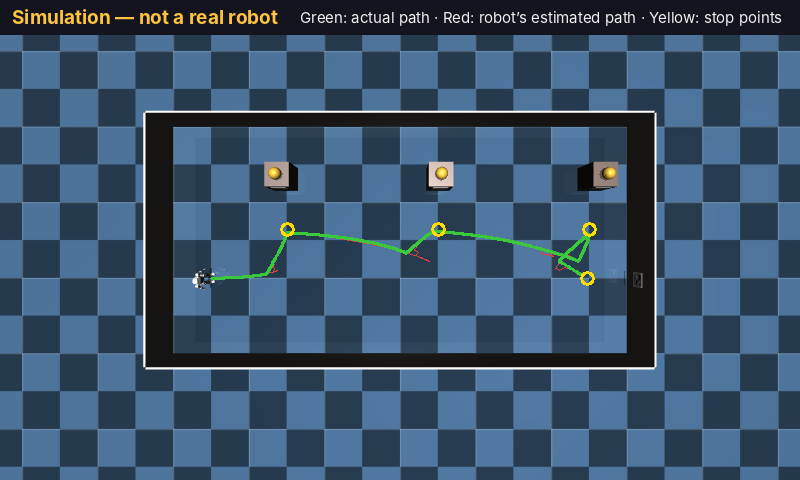
What we learned here is dividing up the share of the failure. The second failure was caused largely not by a bad gait but by the guide program giving commands without knowing the gait's characteristics. Conversely, the homework left on the gait side also became clear. It moves forward less than the commanded speed, and even when told to walk straight it curves a little, so the guide program had to keep correcting the heading. We will address this homework in the next training stage.
How do we judge whether the learned gait is "good"?
Completing the museum course does not mean the gait is good enough, because the guide program covered some of the gait's weaknesses. So we judge the gait itself separately.
We do not trust a number that came out well once. In reinforcement learning, results can differ depending on the start number (seed) chosen when training begins. Looking only at one result that happened to turn out well makes us judge it better than it really is.
So under the same conditions we train three times with only the seed changed, and judge by the average and the worst value of the three results. The judgment is made not in the simulator used for training but after moving the gait to a different simulator (MuJoCo).
What the judgment looks at is this.
- How much the heading drifts when walking forward at a set speed for 10 seconds
- How far it advanced in that time
- Whether it keeps the same gait even when commands arrive slightly late
- Whether it does not fall
When we changed the seed, the gait's robustness came out quite differently from seed to seed, even with the same settings. That is why we do not say "the robustness is good or bad" from one seed.
What were the judgment results?
The gait trained with the first settings fell short of the standard for distance covered in 10 seconds. So we corrected the settings and retrained, and judged the corrected settings by the same method.
We trained three times with the same settings and only the seed changed, and checked the results in MuJoCo with heading correction on, walking forward at 0.5 m/s for 10 seconds (simulation — not a physical K1).
| Item | Average of 3 seeds | Worst value |
|---|---|---|
| Heading error | 3.9° | 8.0° |
| Distance in 10 seconds | 4.35m | 4.24m |
| Heading when commands arrive slightly late | 3.6° | 6.4° |
| Falls | None in all three | — |
The table in "How did it turn out?" above is the result of running the museum course again with the three gaits that passed this judgment.
Were there any problems with the gaits from other seeds?
Yes. When we ran a gait from a different training start number (seed), there was a case where, while it was stopped and waiting, a person remained in a nearby spot the camera could not see, and it started walking again. We changed it so that it does not walk again until it has confirmed the person has left, and after the fix there was no such case in any of the three seeds (simulation).
If we train again with the same seed, do we get the same result?
Yes. When we retrained on the same PC, with the same settings and the same seed, the resulting training file was identical down to the byte. We have not yet checked whether it is the same on a different PC.
However, this is only evidence of reproducibility, that the same conditions give the same result, and not evidence that the settings are good. Whether the settings are good is still judged by the average and worst value over several seeds.
What equipment did we use?
We did the walking training in NVIDIA Isaac Lab, running many virtual K1 robots at once. The official recommendation is an RTX 4080-class GPU with 16GB or more, and we measured training of 4,096 K1 robots at once on an RTX 4060 Ti 16GB (2026-09-17). The museum guide simulation and the judgment were done in MuJoCo (a publicly available physics simulator).
Can we use it right away in a real museum?
Not yet. The results in this article are based on simulation, a clean floor and simple visitor models.
K1's person detection relies on a single head depth camera, so it cannot see the sides, the back, or the area close in front of the body. Real operation therefore needs an accompanying staff member and floor lines (a design based on simulation).
What did we learn from this?
- Learning for walking, rules for route-finding and stopping makes it easier to tell where a failure came from.
- We divide up the share of the failure. We first sorted out whether the problem came from the test program, the guide program or the gait.
- We do not trust a number that came out well once. We train several times with different seeds and judge by the average and the worst value.
- Getting the same result again is reproducibility, not goodness.
Frequently asked questions
Did a physical K1 guide a museum?
No. All of it is simulation. We have not yet put this gait on a physical K1.
If it completed the course, is the gait finished?
No. Part of the completion comes from the guide program covering the gait's weaknesses. We judge the gait itself separately, by the average and worst value over several trainings with different seeds, and the first gait fell short of the distance standard in that judgment, so we corrected the settings and retrained.
What is a seed?
It is the start number chosen when training begins. Even with the same settings, a different seed can give a different training result, so we train with several seeds and look at the results together.
Does it stop when a person approaches from the side?
No. K1's person detection relies on a single head depth camera, so it cannot see the sides, the back, or the area close in front of the body. Real operation therefore needs an accompanying staff member and floor lines (a design based on simulation).
Can a course cover this process?
The scope and method a course covers are explained in the education consultation.
All numbers in this article are based on MuJoCo simulation and have not yet been put on a physical K1. We do not cover rough floors, slopes, thresholds or stairs, or people approaching from the sides, the back, or close in front of the body.
Next step
In the next part, we plan to write about how we refined the gait, and about checking whether the refined gait holds up under other conditions. How a course covers this is explained in the education consultation.
Source: The Booster K1 walking reinforcement learning and museum guide simulation we ran ourselves (2026-09-17 to 10-03). The museum guide simulation was built with MuJoCo, the public K1 model and printable AprilTag markers. The training settings and score design are not included in this article.
The copyright of this article and its figures belongs to SV Robotics. Quotations that credit a link to the original are welcome; reproducing or redistributing the full text, or reposting it as teaching material, requires permission.