
How Does Staff's Night Routine Change When a Patrol Robot Is Introduced?
The robot does not take over the rounds. Staff keep walking them, and the robot tells them first about situations that need checking. Here is what changes and what stays the same before and after adoption.
It does not replace the rounds. It tells staff first where to check.
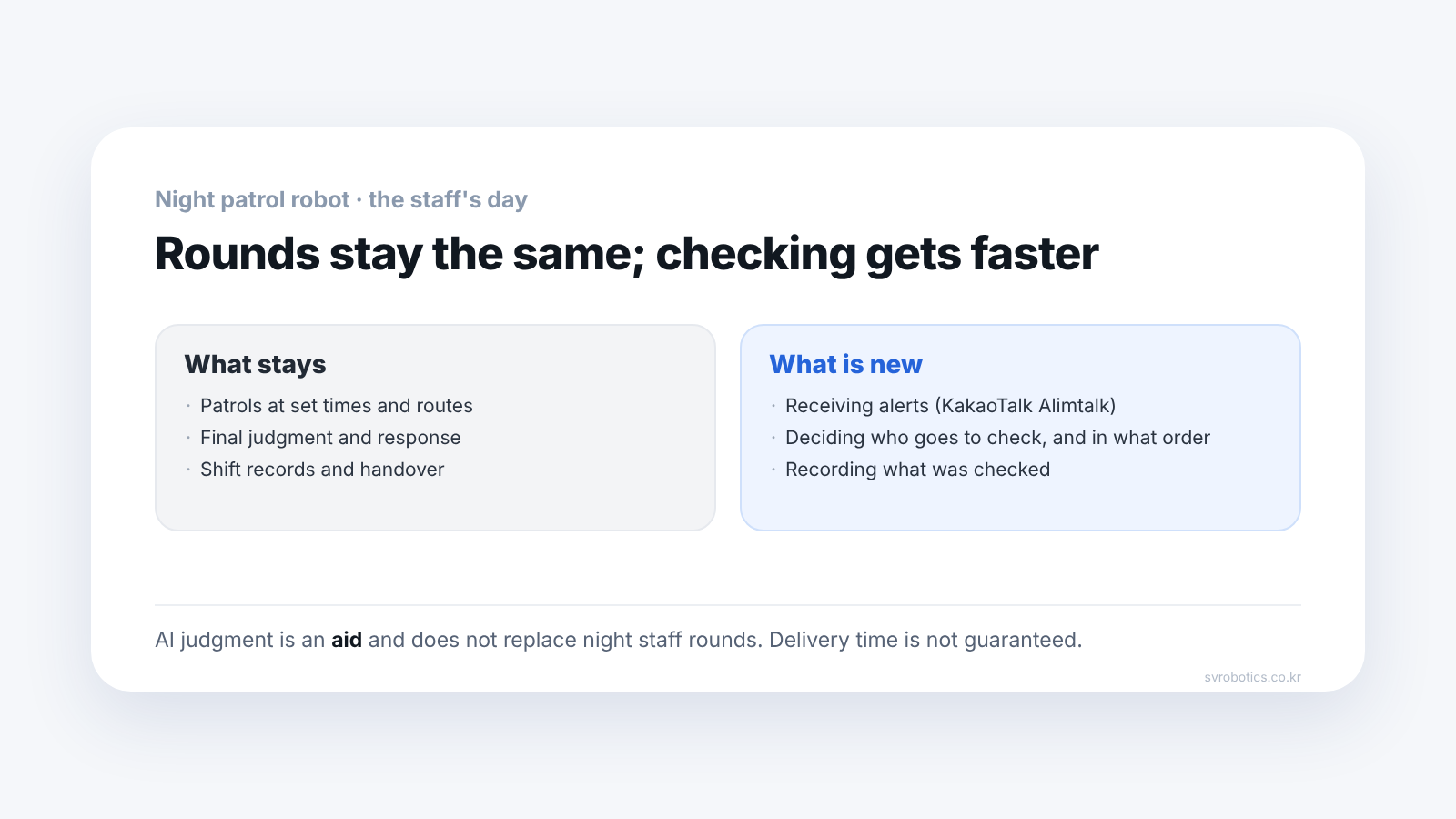
We are often asked, "If the robot patrols, do people not need to?" No. The AI's judgment is an aid and does not replace the night staff's rounds. Instead, it tells staff first about situations that need checking, which helps them decide where to look first.
Below is how the routine changes before and after adoption.
1. What stays the same?
- Scheduled rounds — staff walk them at the times and along the routes the facility sets
- Final judgment and response — even when an alert arrives, it is a person who checks and acts
- Records and handover — shift records and handover stay as they are
The robot does not remove this work. It fills the gaps between rounds.
2. What is new?
Going to check after an alert, and deciding in advance the order in which that happens.
When a suspected fall is detected, a mobile notification (KakaoTalk notification, or Alimtalk) goes to the registered staff member. The delivery time once a fall is detected is within 30 seconds.
So before adoption, we settle these first.
- Who receives the alert — the night staff or the duty supervisor
- Who goes after receiving it — one person, or two together
- What is recorded after checking — the record form and who it is reported to
If this order is not set, an alert will not have any lasting effect.
3. What does the robot tell you?
There are three kinds of alerts at present.
- Fall candidate — it finds people in the photos taken during patrol, and if a person is lying or slumped on the floor rather than on a bed or chair, it reports a fall candidate.
- Alert when a person is found in a designated time window and place — if a person is found in the time window and place set at installation to match the customer's request (the area the robot patrols), it is reported as something for staff to check. It can be adjusted if needed.
- Patrol gap — if the previous night's patrol photos were fewer than usual or missing, the manager is told the next morning.
What it does not do is also clear. It makes no medical diagnosis. It reports a fall candidate only and does not judge the cause or any illness.
The differences between methods are set out in Fall detection: how do you choose between sensors, mats, video and patrol robots?
4. Doesn't it add to the workload?
At first it takes effort. Checking alerts is a new task, and there is also charging the robot and looking after its route.
What decreases is the uncertainty of "is something happening right now?" Things that happened between rounds used to be found at the next round; now you learn of them first through an alert.
Which side is bigger depends on the facility's night staffing and floor layout. So before adoption, we look together at the current rounds and staffing.
5. What needs to be prepared?
- Whether corridor Wi-Fi stays connected throughout the patrol area
- The robot's charging spot (a location with power)
- Who receives alerts and the response order
- The video handling standard and how to inform residents and guardians — we work these out with the facility before the demo
Frequently asked questions
If the robot patrols, can we cut back on night rounds?
No. The AI's judgment is an aid and does not replace staff rounds. Keep the rounds as they are and use the robot to report situations that need checking in between.
If alerts come often, won't the workload grow?
The alert targets and time windows are set according to the standards the facility decides. We start on the premise that they will be adjusted as you operate.
Will the robot help someone who has fallen to get up?
No. It is a safety aid that reports situations that need checking, and staff do the responding.
Can we see it first?
A remote demo takes 30 minutes, and an on-site demo at your facility takes 90 minutes. Running it at your facility for a set period is discussed separately, together with the installation schedule.
Next step
If you tell us your current night rounds, staffing and floor layout, we will start by looking together at which sections it could help. You can see the alert flow first in a 30-minute remote demo. What to tell us before a consultation is set out on the nursing home fall alert AI robot page.
Sources: SV Robotics AI care facility patrol robot solution page (detection items, alert method, pre-adoption checks; checked 2026-09-21). Organization names and detection performance figures are not given.