
Fall Detection: How Do You Choose Between Sensors, Mats, Video and Patrol Robots?
Wearable sensors see only when worn, mats only where they are laid, fixed cameras only what they film, and patrol robots only the route they pass. Start with what each method tends to miss, then use this guide to combine them.
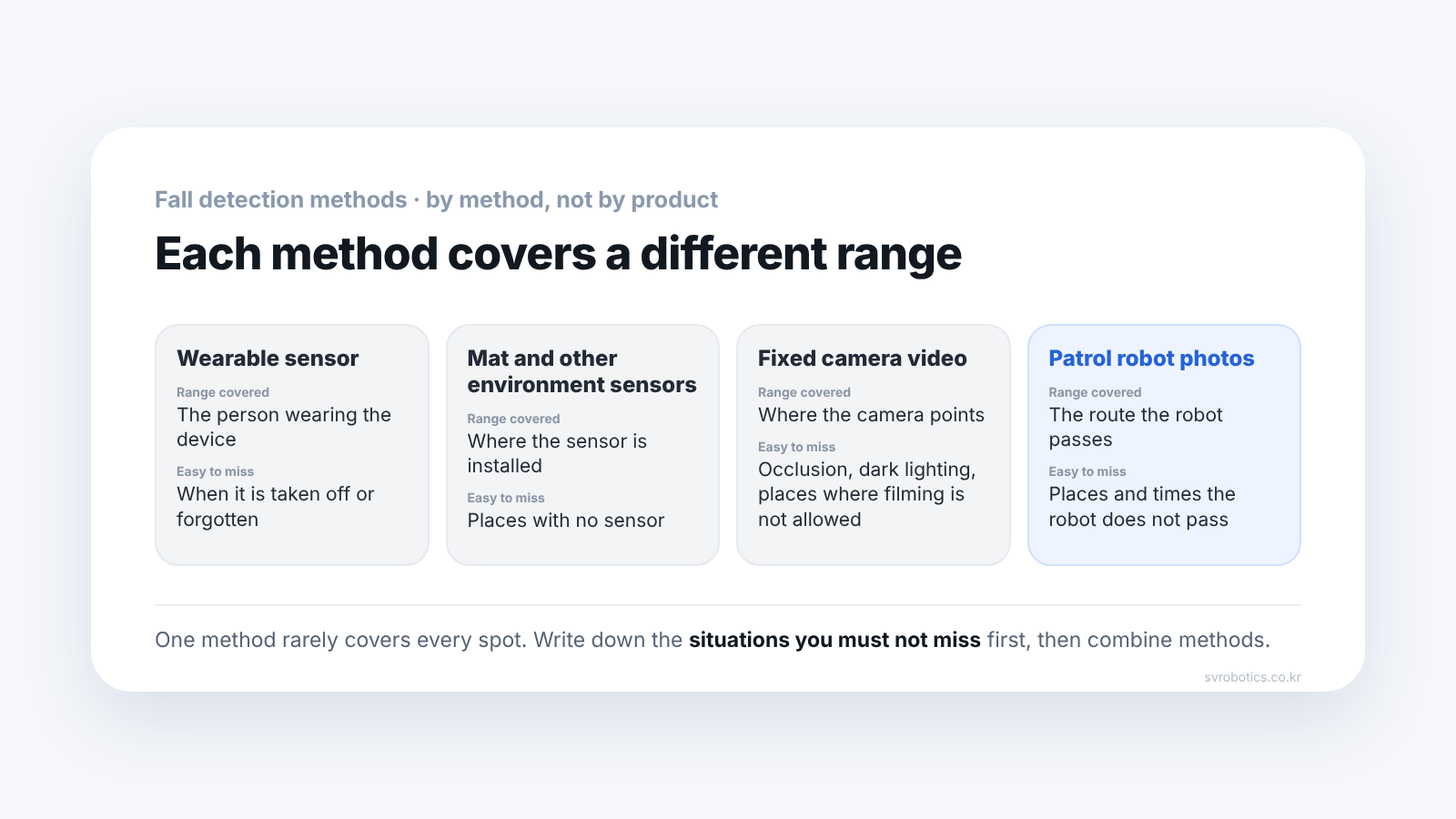
Each method has a different "range it sees." Wearable sensors see only when worn, mats only where they are laid, fixed cameras only what they film, and patrol robots only the route they pass. So rather than asking "which method is best?", choose by which situations our facility cannot afford to miss.
The descriptions of the methods below are based on published literature that reviews fall detection research. For the patrol robot method, we describe only the features our nursing home fall alert AI robot solution provides today. We do not compare specific products.
How are fall detection methods divided?
Research usually divides them into methods worn on the body, methods installed in the surroundings, and video methods. Adding a patrol robot that takes photos while on patrol gives four.
| Method | How it knows | Range it sees |
|---|---|---|
| Wearable sensor | Accelerometer and gyroscope in a wrist or necklace device | The person wearing the device |
| Environmental sensor (mats, etc.) | Pressure sensors, infrared, radar, etc. placed on the floor or bed | The spot where the sensor is installed |
| Fixed camera video | Analysis of video from a camera mounted in one place | What the camera films |
| Patrol robot photos | Judgment of photos the robot takes while on patrol | The route the robot passes |
What do wearable sensors tend to miss?
Times when they are not worn. Published studies commonly point to battery management, regular checks, and falls that happen when the wearer has forgotten or taken off the device as limits of wearable devices.
Questions to check:
- Can the resident wear the device at night as well?
- Who charges and checks the batteries, and when?
What do environmental sensors such as mats tend to miss?
Spots with no sensor. Pressure mats and floor sensors notice changes at the spot where they are installed, so sensors have to be installed separately for each space you want to cover. The literature cites the installation burden and the possibility of false alarms that vary with the environment as limits.
Questions to check:
- Are the places you worry about fixed, like beside a bed, or spread widely, like corridors and restrooms?
- Where can sensors be laid, and where can they not?
What do fixed camera videos tend to miss?
Places the camera does not film, and conditions where things are hard to see. The video method has the advantage that nothing needs to be worn on the body, but the literature points out that performance varies with camera position, lighting, and occlusion, and that privacy is a major issue in spaces such as bedrooms and bathrooms.
Questions to check:
- Can a camera film the spots you worry about without obstruction?
- Is the video clear enough under night lighting?
- How will you divide spaces where filming is allowed from spaces where it is not?
What does the patrol robot method do, and what does it tend to miss?
It watches a wide area by moving through it, such as corridors across several floors and buildings. In exchange, it works from photos taken during patrol, so it cannot see places and times the robot does not pass.
Our solution currently provides three kinds of alerts.
- Fall candidate — It finds people in the photos taken during patrol, and if a person is lying or slumped on the floor rather than on a bed or chair, it reports a fall candidate.
- Alert when a person is found in a designated time slot and place — When a person is found in a time slot and place set at installation to match the customer's request (within the area the robot patrols), it is reported as something for staff to check. It can be adjusted if needed.
- Patrol gap — If the previous night's patrol photos were fewer than usual or missing, managers are told the next morning.
It makes no medical diagnosis. It only reports fall candidates; it does not judge the cause or any illness. Depending on the facility's network and operating policy, the sensor setup, such as the robot and fixed cameras, can be adjusted.
How do you choose for your facility?
Write down the situations you cannot afford to miss, and pair each with the method that sees it.
| Situation the facility worries about | Method to consider first |
|---|---|
| A specific resident falling beside the bed | Environmental sensor or wearable sensor at that spot |
| Night situations in corridors and common areas across several floors | Patrol robot photos, fixed cameras in common areas |
| Whether night patrols were actually carried out | Patrol records (patrol gap alert) |
| Residents who have difficulty wearing a device | Environmental sensors or video that need nothing worn |
It is hard for one method to cover every spot. Even when you combine several methods, they work only if you first decide who receives the alerts and who goes to check after an alert.
Frequently asked questions
What is the most accurate fall detection method?
Each method differs in the range it sees and the conditions where it tends to miss, so it is hard to answer with a single method. We suggest first sorting out the places and times you worry about, whether residents can wear a device, and which spaces can be filmed.
Does the video method have no privacy issues?
Be especially careful in spaces such as bedrooms and bathrooms. Decide the video retention period, viewing permissions, and standards for informing residents and guardians before adoption, and check the legal standards that apply to your type of institution with your institution's responsible department.
Does a patrol robot also alert you to falls inside a room?
It works from photos taken during patrol. It cannot see inside rooms the robot does not pass, so plan for those spots together with other methods.
Does a fall detection system prevent falls?
Detection helps staff notice quickly after someone has fallen. Fall prevention activities need to be planned separately.
Next step
Which method fits depends on night staffing and on who goes when an alert comes in. If you cannot decide whether a patrol robot suits you, you can see actual alerts first in a 30-minute remote demo. What the patrol robot method does and does not do is gathered in one place on the nursing home fall alert AI robot page.
Sources: "Real-Time Vision-Based Fall Detection Systems for the Elderly: A Systematic Review" (Sensors, 2026), "Elderly Fall Detection Systems: A Literature Survey" (Frontiers in Robotics and AI, 2020), SV Robotics AI care facility patrol robot solution page (checked 2026-09-18). Accuracy figures for each method are not given because they vary with each study's conditions.