
AGV vs AMR: What Is the Difference?
An AGV follows guides laid on the floor, such as tape or markers. An AMR builds a map of the site and chooses its own route. The difference shows when something blocks the path, when the line changes, and on installation day. This is a checklist for plant managers before they buy.
An AGV follows a guide laid on the floor. An AMR looks at a map it built itself and picks its own route. That one difference shows up when an obstacle appears, when the factory line changes, and on the day you install.
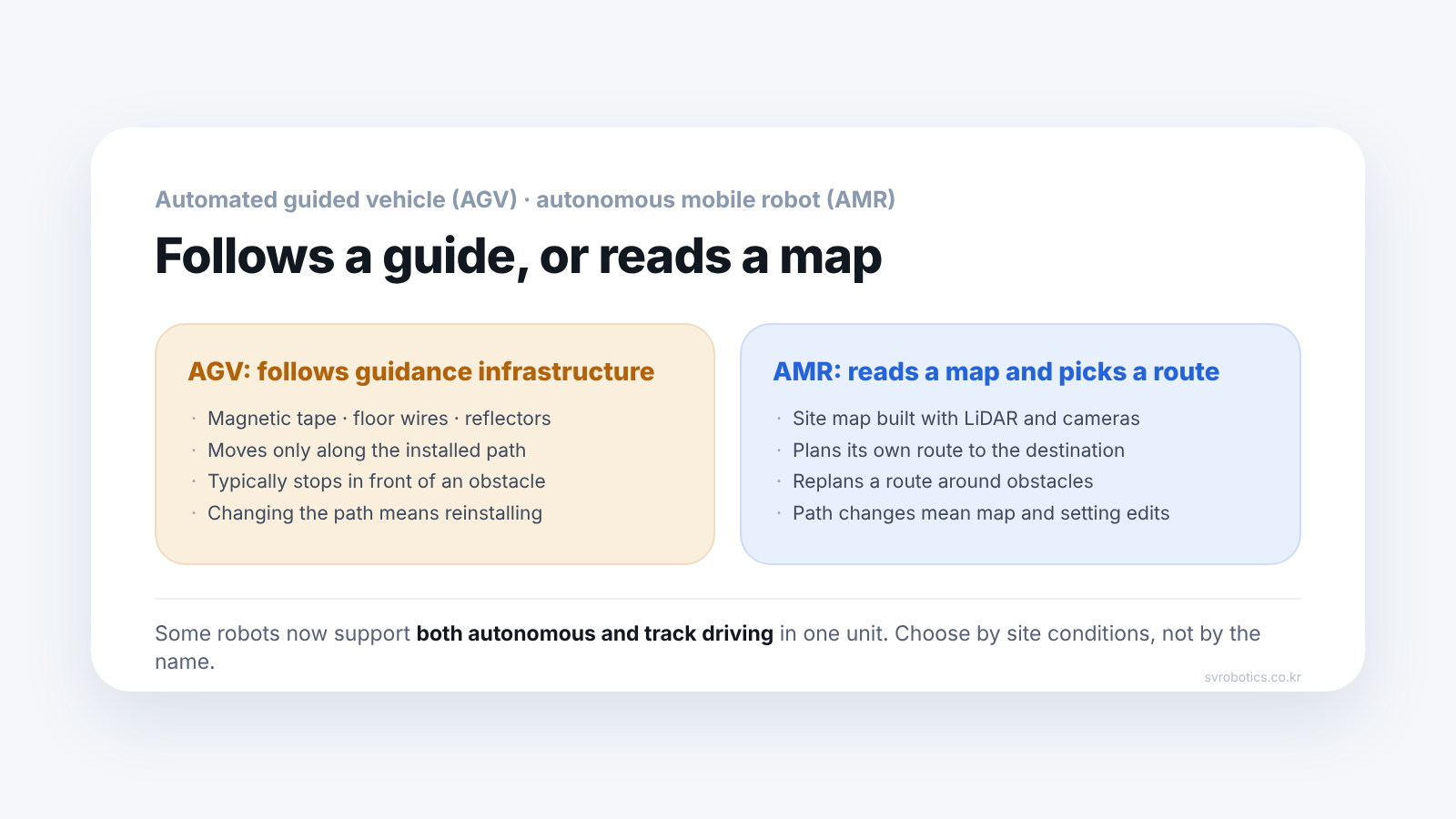
- AGV (Automated Guided Vehicle) — moves along a fixed route by following guidance infrastructure: magnetic tape, wires under the floor, reflectors or markers
- AMR (Autonomous Mobile Robot) — builds a map of the site with sensors such as LiDAR and cameras, then plans its own route to the destination on that map
Below we set the usual industry definitions next to the public specifications of AUTOXING products, which we supply as an official partner.
How does each one find its way?
For an AGV the guidance infrastructure is the route. For an AMR the map is the route.
| AGV | AMR | |
|---|---|---|
| Guide | Magnetic tape, floor wire, reflectors or markers | A map of the site built from sensors |
| Route | Wherever the infrastructure was laid | Planned by the robot on the map |
| Locating itself | Reads the infrastructure | Compares what the sensors see with the map |
AGVs come in several kinds. The common ones read the magnetic field of a wire under the floor, follow magnetic tape on the floor, or read reflectors on walls and equipment with a laser to calculate position.
What happens when something is in the way?
A traditional AGV stops and waits. An AMR looks for a way around.
An AGV cannot leave its route. When something is placed in front of it, the usual behavior is to stop and wait until someone clears it. An AMR detects the obstacle with its sensors, then slows down, stops, or plans a new route around it.
For example, the AUTOXING Smart Pallet Truck (FT1500 and FT2000) perceives its surroundings with several sensors including LiDAR and depth cameras, and is described as going around an obstacle and returning to the set route.
What changes when the line changes?
An AGV needs its floor infrastructure laid again. An AMR gets a new map and route.
To change the route of an AGV that follows guidance infrastructure, you peel up the tape and lay it again, or move the markers. For an AMR you change the map and route settings.
- AUTOXING L300 (lifting AMR) — designed to be mapped and used without fixed infrastructure such as QR codes or reflectors, and described as running again after you reset the route when the line changes. The manufacturer cites about 10 minutes for on-site mapping and basic deployment
- AUTOXING Smart Pallet Truck — described as handling layout changes with over-the-air (OTA) updates and partial map updates
The "10 minutes" is the manufacturer's figure. On a real site, preparation time depends on the number of zones, the crossings and the equipment around the route, so a pilot section gives a more accurate answer.
Can you separate the two cleanly?
Today one robot can support both methods. For example, the AUTOXING Sub Lift AMR S Series is described as supporting free driving, track driving and hybrid driving, plus a Follow mode. That means one robot can choose between map-based driving and fixed-route driving, and a site review decides which method goes where.
So instead of asking "AGV or AMR?", it is more practical to ask what our site needs.
Which one suits our factory?
Look at whether routes change often, whether people share the aisle, and whether you can lay anything on the floor.
| Site condition | Look at first |
|---|---|
| The route has been the same for years and has its own aisle | A fixed-route method is also worth considering |
| The line layout changes often | Map-based (AMR) |
| People and forklifts use the same aisle | An AMR that goes around obstacles |
| Tape or markers are hard to lay on the floor | An AMR that maps without fixed infrastructure |
| Needs to change floors or pass automatic doors | A model that supports elevator and automatic door integration |
Either way, settle these first: maximum payload, minimum aisle width, floor slope and thresholds, crossings, charging position, and MES/WMS integration needs. For example, the official material for the L300 gives a maximum of 300 kg, a minimum aisle width of 70 cm, 20 mm obstacle clearance and slopes up to 8°.
Frequently asked questions
Does an AMR need nothing installed on the floor?
Map-based AMRs are often designed to run without guidance infrastructure such as tape or markers. The AUTOXING L300 is described as designed to be mapped and used without fixed infrastructure such as QR codes or reflectors. A charger location and the equipment for elevator and automatic door integration are still prepared separately.
Is the AGV obsolete?
No. At a site where the route has not changed for a long time and has its own aisle, a fixed-route method is still worth considering. Some robots also support free driving and track driving together.
If several run together, do they collide?
AUTOXING describes multi-robot scheduling that includes task assignment, route planning and collision avoidance. In real operation the settings follow the crossings and aisle widths.
How is the price decided?
It depends on the type and number of robots, on the fleet management for running several, and on the scope of elevator, automatic door and MES integration, so it is given as a quote.
Next step
The answer depends on whether you can lay guides on the floor and how often the route changes. Tell us the weight you move now and how many trips you make a day, and we will look at which method fits.
Sources: Official AUTOXING material for the L300, Smart Pallet Truck and Sub Lift AMR, and SV Robotics product pages (checked 2026-09-18); Wikipedia, "Automated guided vehicle" (classification of guidance methods); SICK, "AGV, AGC, AMR, IMR – what does it all mean?" (2022-09-21). Prices vary by configuration, so none are given here.