
How Much Does an AMR Cost? What Goes Into the Quote
The price is not set by the robot alone. What you move and how heavy it is, integration with site equipment, charging spots and operations support all go into the quote. This post goes through each item that changes the amount.
Asking only for the robot price will not get you a quote. What you move, how heavy it is and how many trips you make come first.
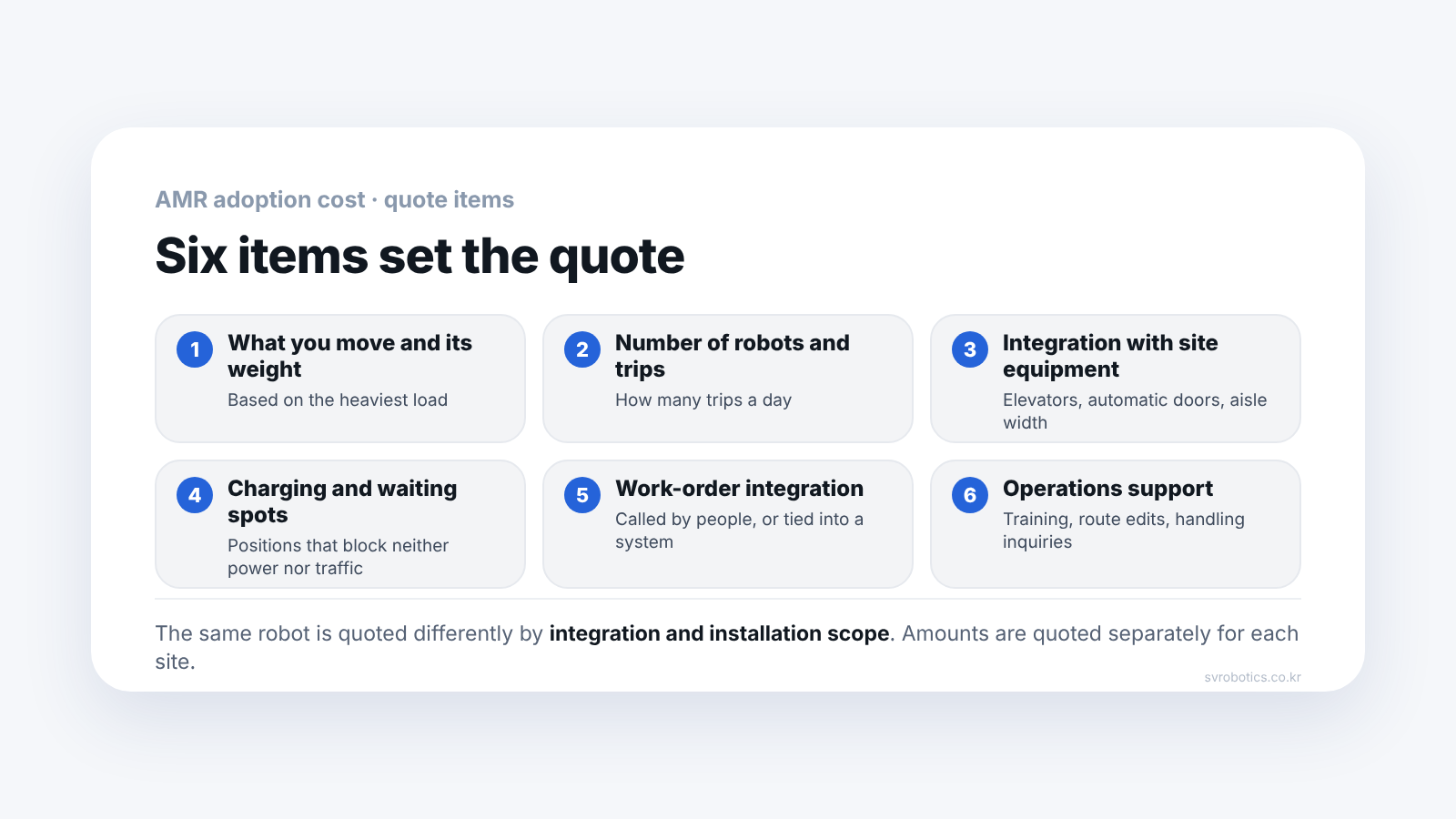
We often get the question "How much is one AMR?" But even for the same robot, the items that go into the quote change with site conditions. Below we list which lines appear on the quote, item by item. We have not written any amounts.
1. What you move and how heavy it is
This is the item that splits the options most. The robot type depends on whether you move pallets, whole shelves or carts you tow.
The AUTOXING product line that we supply is divided by the kind of work.
- Carrying pallets up to 1.5 to 2 tons: Smart Pallet Truck / FT1500
- Going under a shelf and moving it whole: Sub Lift AMR
- Lifting racks or materials for repeated transport: L300 / Lift AMR
- Connecting directly to a conveyor: Conveyor Robot
- Delivering general materials on a production line: Factory Delivery Robot
- Large, heavy-load materials: Heavy Load AMR
Base the choice on the weight at its heaviest. If you choose by the usual weight, the robot stops on a busy day.
2. Number of robots and trips
How many trips you make per day sets the number of robots. Multiply the time for one round trip by the number of trips per day and you can see whether one robot is enough or two are needed.
More robots do not only add robot cost. When several robots share the same aisle, traffic management (dispatching) comes with them.
3. Does it need to connect to site equipment?
If the robot has to open elevators, automatic doors or shutters by itself, integration work is added.
- Does it need to move between floors?
- Does it pass through automatic doors or shutters?
- How many mm wide is the narrowest point of the aisle?
- Are there floor thresholds, slopes or drains?
On the quote this item appears as installation and integration cost. If you have drawings or photos, we can check these in advance.
4. Charging and waiting spots
The place where the robot rests has requirements too. You need power and space for the charger, and a waiting position that does not block traffic. At a site that runs 24 hours, charging time has to go into the operating plan.
5. How are work orders given?
Preparation differs between people calling the robot with a button and a system assigning tasks automatically. If the robot has to connect to a warehouse management system (WMS) or manufacturing execution system (MES), the scope of integration has to be set, and that scope becomes a line on the quote.
6. Scope of operations support
Who handles what after adoption is also part of the quote. If you write down how training for site staff, route changes and inquiry handling are divided, it is easier to compare quotes later.
What should you tell us when you request a quote?
These six things are enough for a first quote.
- What you move and its weight at the heaviest
- Start and end points, and the number of trips per day
- The narrowest aisle width along the route
- Whether the route passes through elevators or automatic doors
- Where the charger would go and where power is available
- How work orders are given (called by a person / integrated with a system)
Prices depend on site conditions, so we give them as a separate quote.
Frequently asked questions
Can I get just the price of one AMR?
Even for the same robot, the quote changes with the scope of integration and installation. If you tell us the six items above, we will give you a figure for those conditions.
Can I keep using the carts I have now?
It depends on the size and underside structure of the cart. We first check whether towing or lifting suits it.
Do I have to lay lines or markers on the floor?
An AMR is a method that does not use floor lines. The difference from methods that do is covered in AGV vs AMR: What Is the Difference?.
Can I start with one and add more?
Yes. It is better, though, to plan the route from the start with dispatching in mind for when several robots share the same aisle.
Next step
Tell us only what you move and its weight at the heaviest, the number of trips per day, and the narrowest aisle width, and we will first narrow down which method fits. If you have a site drawing or photos of the aisles, please send them too.
Sources: Official AUTOXING product line material and SV Robotics product pages (product grouping by kind of work, checked 2026-09-21). Amounts are given as a separate quote based on site conditions.