
Which AMR Fits Our Site? Choosing by What You Move
AMRs look like a long list of models, but the selection criterion is one thing. What do you move? This post sorts them into seven branches, covering pallets, shelves, racks, conveyors, materials, heavy loads and in-facility delivery.
Starting from model names is confusing. Write down what people are moving now, and the branch becomes clear.
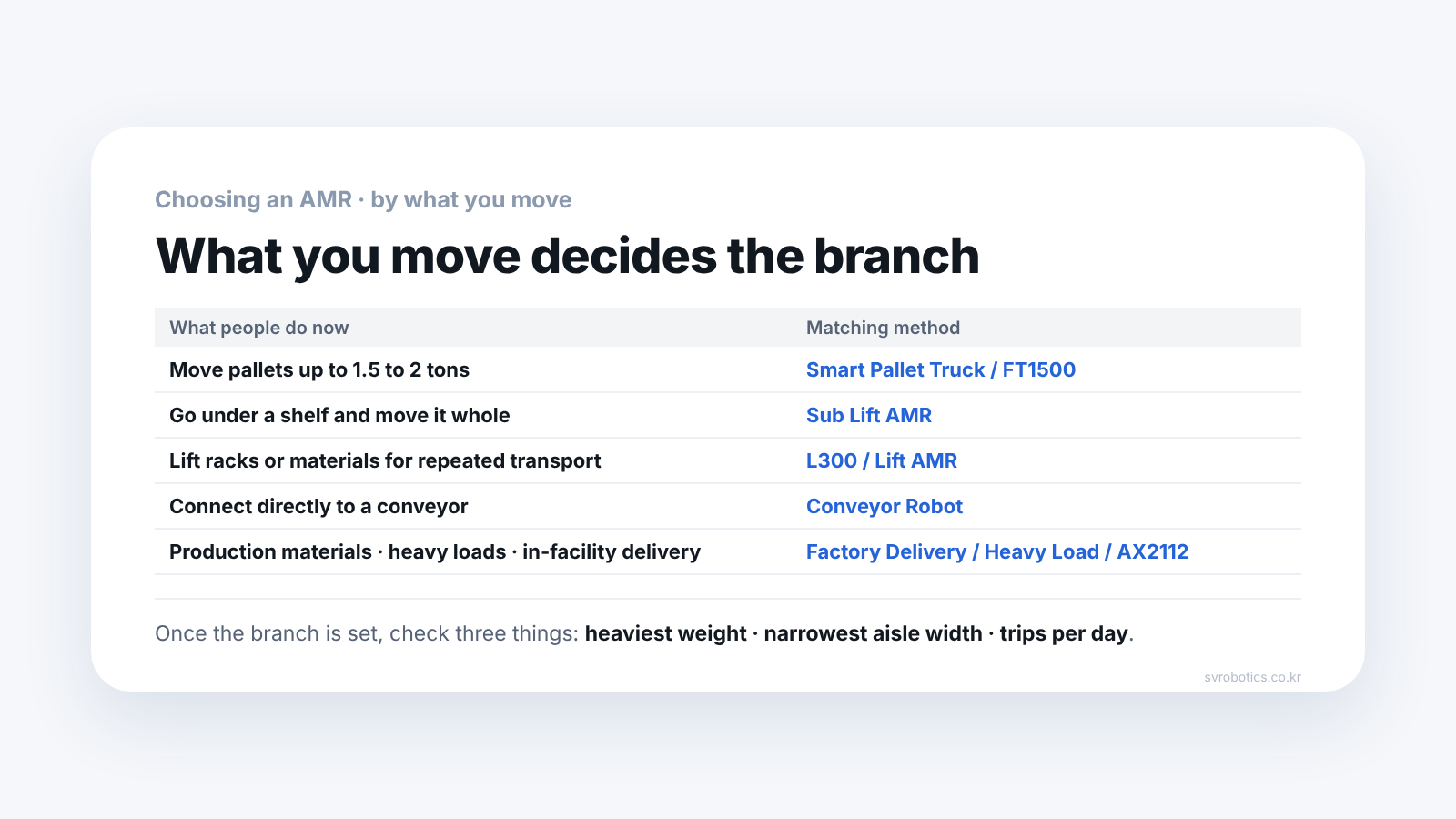
When you look into AMRs, several names come up. But the selection criterion is one thing: what you move, and in what shape. The AUTOXING product line that we supply is also divided by the kind of work.
1. What are the seven branches by what you move?
| What people do now | Matching method |
|---|---|
| Move pallets up to 1.5 to 2 tons | Smart Pallet Truck / FT1500 |
| Go under a shelf and move it whole | Sub Lift AMR |
| Lift racks or materials for repeated transport | L300 / Lift AMR |
| Connect a conveyor and a robot directly | Conveyor Robot |
| Carry general materials to a production line | Factory Delivery Robot |
| Move large, heavy-load materials | Heavy Load AMR |
| Deliver items inside a facility | Hotel Robot AX2112 |
Many sites have a mix of two. In that case, start with the one section that repeats most often.
2. What do you check once the branch is set?
Three numbers.
- Weight at its heaviest. Use a busy day, not the usual weight
- Narrowest aisle width. Look at the width to pass through and the space to turn together
- Trips per day. This decides whether one robot is enough or several are needed
For example, the L300 is on the side of repeatedly carrying 300 kg-class racks and materials through narrow aisles, while the Conveyor Robot R100 is on the side of linking equipment with a 100 kg payload and ±10 mm stopping position accuracy. Even within the same "transport", the conditions differ.
3. How do you look at site equipment?
- Moving between floors. Does the robot need to call the elevator itself?
- Automatic doors and shutters. Are there doors it has to pass through?
- Floor. Are there thresholds, slopes or drains? (For the L300, the specifications list conditions of about 20 mm obstacles and slopes.)
- Charging spot. Power, and a position that does not block traffic
These items appear on the quote as installation and integration cost. The details are in How Much Does an AMR Cost? What Goes Into the Quote.
4. Do you have to start with several robots?
No. It is safer to start with one robot in one section and add more after measuring the actual number of trips. If you already know you will expand later, though, it is better to build traffic management for several robots sharing an aisle into the first route design.
5. How does people's work change?
Repeated transport decreases, and checking and exception handling remain. People are the ones who clear something left in the aisle, pick out pallets of a different size, and look into why a robot stopped. If you decide who takes that role before adoption, operations do not break down.
Prices depend on site conditions, so we give them as a separate quote.
Frequently asked questions
If I move several kinds of things, can one robot do all of it?
If the shapes differ, the way of lifting differs, so it may be hard to cover them with one robot. Decide on the one that repeats most often first, and review the rest afterward.
What is the difference between moving a whole shelf and lifting materials?
In the whole-shelf method, the robot goes under the shelf and lifts it. The material-lifting method targets items on a rack or a stand. It depends on the structure of the site.
Do I need to connect it to my existing warehouse system?
You can start with a method where people call the robot, or integrate it with warehouse and production systems. The wider the integration, the more there is to prepare.
How is it different from an AGV?
The dividing point is whether you lay lines or markers on the floor. It is covered in AGV vs AMR: What Is the Difference?.
Next step
Tell us what people carry now and its weight, the start and end points, and the number of trips per day, and we will first narrow down which branch fits. If you have site photos or a drawing, we will look at the aisle conditions too.
Sources: Official AUTOXING product line material and SV Robotics product pages (product grouping by kind of work, public specifications of the L300 and Conveyor Robot R100, checked 2026-09-21). No amounts are given.