
How Much Floor Can One Cleaning Robot Cover in a Day?
The hourly area on a spec sheet is a maximum or average figure. What a robot actually cleans in your building comes from the aisle layout and the hours you can run it. This post sets out the order of the calculation and the reasons the number drops.
Spec sheet figures multiplied by operating hours do not give the real result. The more complicated the aisles, the lower it gets.
"How much area does it clean in a day?" is the question we get most often. The honest answer is that we have to see the site. The order of the calculation is fixed, though, and once you know it you can estimate roughly what to expect in your own building.
1. What does the number on the spec sheet mean?
It is an average for cleaning in straight lines with nothing in the way. These are the public specifications of the two LionsBot models we supply.
| Item | R3 Scrub Pro | R5 |
|---|---|---|
| Average cleaning efficiency | 800–1,200㎡ per hour | 1,300㎡ per hour |
| One charge | Up to 3 hours | Up to 5,000㎡ · 4 hours 20 minutes |
| Clean water tank | 21L | 50L (dirty water 40L) |
| Body width | 570mm | Wider (weighs 200kg) |
The wide range for the R3 Scrub Pro, 800–1,200㎡, is already a hint. The same robot can differ by a factor of 1.5 depending on the site.
2. Why is the real figure lower than the spec sheet?
There are four reasons.
- Turning and avoiding — While it moves between shelves and changes direction, the area it cleans goes down
- People and objects — If visitors are present or things are left in the way, the robot stops or goes around
- Filling and emptying water — When the clean water runs out, it has to be refilled. The smaller the tank, the more often it stops
- Charging — Once you go past the continuous run time, it needs charging
So a wide, open common area comes out close to the spec sheet, while a store with densely packed shelves should be planned lower.
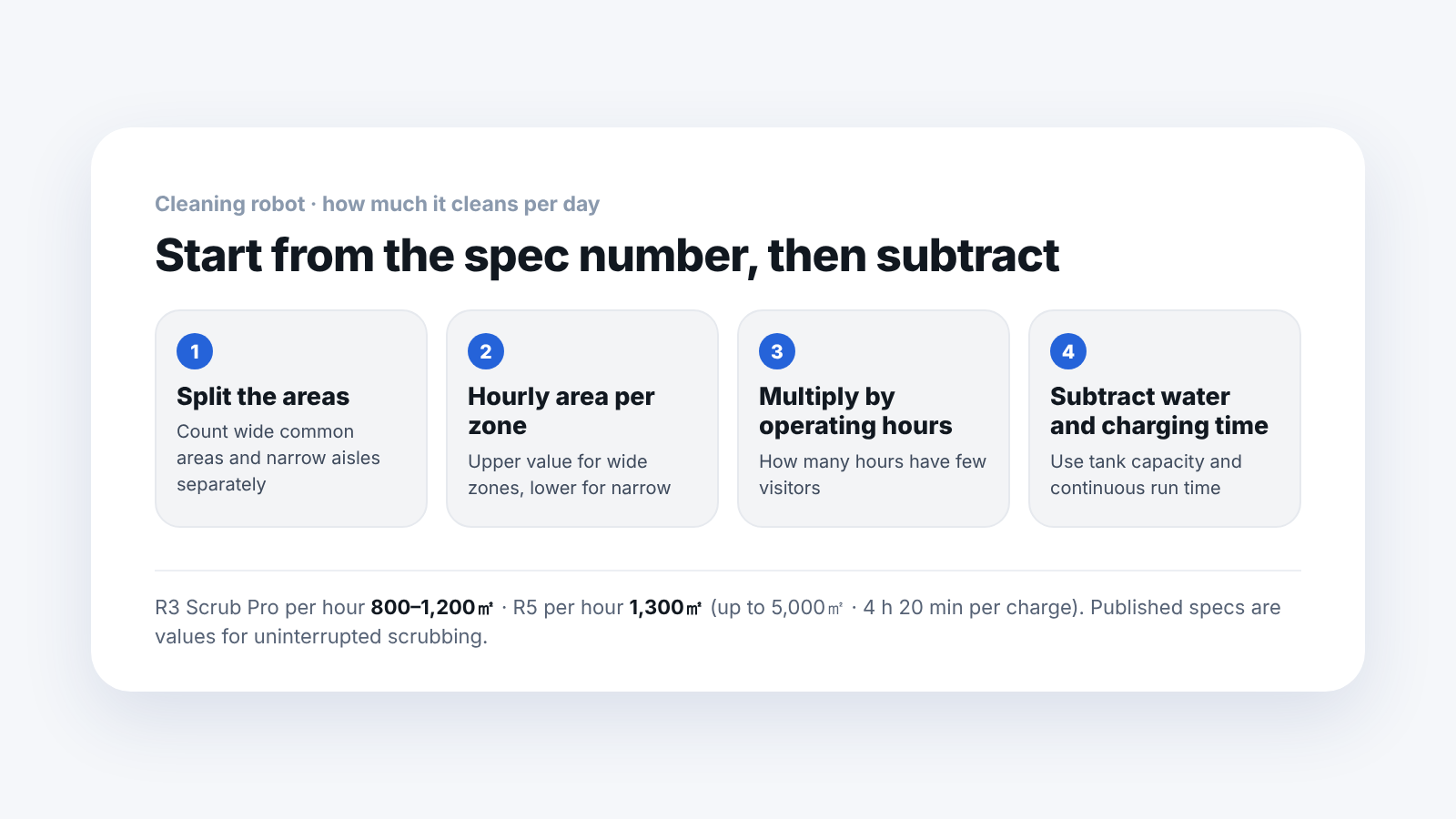
3. How do you calculate it for your own building?
In four steps.
- Divide the area to be cleaned into zones — List wide common areas and narrow-aisle zones separately
- Use a different hourly area for each zone — Toward the top of the spec range for wide areas, toward the bottom for narrow ones
- Multiply by the hours you can run — How many hours a day are quiet enough
- Subtract water refill and charging time — Work out how many times from the tank capacity and the continuous run time
For example, in a building that is mostly wide common areas and can run for 4 hours at night, you can work out whether one robot could cover several thousand ㎡ a day. On the other hand, for a store with many narrow aisles, it is safer to plan on about half that in the same time.
4. How do you reduce the number of water refills?
It depends on the tank capacity and an automatic fill-and-drain station. For the R3 Scrub Pro you can choose a station that charges and fills and drains water automatically. People walk back and forth with water less often, but in exchange you need to check where the station will go and where the piping is in advance.
5. When do you get an exact number?
After we have seen the site. If you send a floor plan or photos of the aisles, the floor material and the hours you can run, we will calculate it zone by zone. We also decide together, in the consultation, how to confirm the figure in actual operation.
Prices vary with site conditions and are given as a separate quote.
Frequently asked questions
Should I not trust the spec sheet number as it is?
The number is not wrong. It is an average for cleaning with nothing in the way, so at a site with complicated aisles you need to plan lower for the plan to hold.
What if one robot is not enough?
You can split the area and run two robots, or lengthen the operating hours. Which is better depends on the building layout and the hours it is in use.
How does it compare with a scrubber that a person pushes?
The way it cleans is similar. The difference is that it repeats a set area without a person staying beside it. People still handle the places that need hands, such as corners and stairs.
Does it clean carpeted areas too?
An autonomous scrubber cleans hard floors with water. If carpeted areas are mixed in, those areas have to be planned separately.
Next step
Send us the area of each zone, the width of the narrowest aisle and the hours you can run, and we will calculate how much can be cleaned in a day. If you have a floor plan, we will help divide it into zones as well.
Sources: Official LionsBot R3 Scrub Pro and R5 product pages and SV Robotics product pages (cleaning efficiency, tank and continuous run time, checked 2026-09-21). Actual area varies with site conditions and is calculated separately.