
Care Robots: What Types Exist and What Should You Weigh First?
Care robots do very different jobs. Sorting them into robots that physically assist the body, robots that watch over safety and send alerts, and robots that guide and talk makes them easier to evaluate. This post covers the nature of each type, five things to weigh before adoption, and what we offer today.
The single term "care robot" covers robots that do very different jobs. Sorting them into three groups first makes them easier to evaluate.
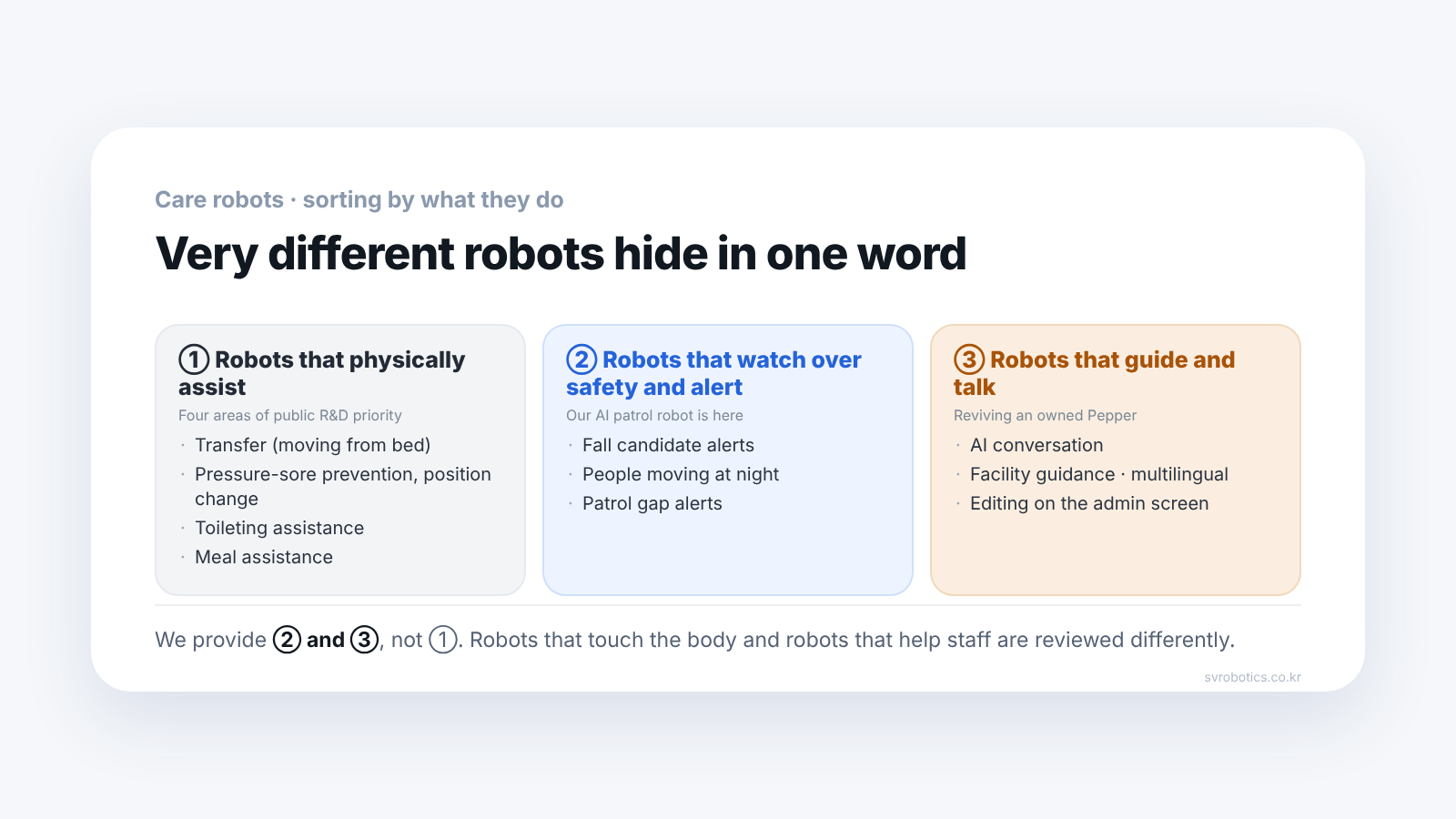
- Robots that physically assist the body: they support care that touches the body, such as transferring, repositioning, toileting and feeding
- Robots that watch over safety and send alerts: they patrol or watch through cameras and alert staff to situations that need checking
- Robots that guide and talk: they help with facility guidance, conversation, and running events and education
Below are the nature of each group, what to weigh before adoption, and the scope we offer today. We have not compared any specific company's products.
1. What robots physically assist the body?
The four areas that public research names as priorities are a useful reference. The care robot brokerage research at the Rehabilitation Research Institute of the National Rehabilitation Center introduces four priority areas: transfer (moving a person from one seat to another), pressure ulcer prevention and repositioning, toileting, and feeding.
Because robots in this group touch the person's body, who they are used for and in what situation must be settled first. We do not supply products in this group. If you are evaluating one, it is better to talk to a company that develops and supplies that area.
2. What do robots that watch over safety and send alerts do?
They pick out situations that staff should check first and send an alert. Our AI nursing home patrol robot belongs here, and it currently provides three kinds of alerts.
- Fall candidate: the robot finds a person in a photo taken on patrol, and if the person is lying or slumped on the floor rather than on a bed or chair, it reports a fall candidate.
- Alert when a person is found in a designated time window and place: if a person is found in the time window and place (the area the robot patrols) set at installation to match the customer's request, it is reported as something for staff to check. This can be adjusted if needed
- Patrol gap: if the previous night's patrol produced fewer photos than usual, or none, the manager is notified the next morning
It does not make medical diagnoses. It only reports a fall candidate and does not judge the cause or any illness. The final judgment and response are up to staff.
When a suspected fall is detected, a mobile notification (KakaoTalk Alimtalk) is sent to the registered contact. Once detected, delivery to the contact takes 30 seconds or less. The AI judgment is an aid and does not replace night staff rounds.
If you want to break down detection methods further, see Fall detection: how do you choose between sensor, mat, video and patrol robot methods?.
3. What do robots that guide and talk do?
They handle facility guidance and conversation. We offer a way to reuse a Pepper you already own through software (AnsimRobo for SoftBank Pepper). Without modifying the hardware, it connects AI conversation, facility guidance, multilingual responses and no-code editing from the admin screen.
Before adoption, we first check the Pepper's model, its software state, the network and the operating purpose. The starting point differs from evaluating the purchase of a new robot.
What should you weigh first before adoption?
Five things.
| What to weigh | Why |
|---|---|
| Who uses it | Whether the robot touches residents' bodies or helps staff completely changes how you evaluate it |
| Whether staff work grows or shrinks | Checking and responding to alerts is new work. Without a set order for it, the effect shrinks |
| Video and personal data | For a robot that uses video, first set the retention period, access rights, and the standard for informing residents and guardians |
| Installation environment | Measure the Wi-Fi in the patrol area, the robot's charging spot, and the corridors and thresholds |
| Support programs | The support programs available differ by type of institution. Check with the institution's responsible department |
The second and third matter most in actual operation. The robot only pays off when it is settled who goes to check when an alert arrives.
How far does our scope go?
Safety monitoring with alerts, and guidance and interaction.
- AI nursing home patrol robot: fall candidate detection, an alert when a person is found in a designated time window and place, and patrol gap monitoring. Depending on the site network and operating policy, the sensor configuration, such as the robot together with fixed cameras, can be adjusted
- AnsimRobo for SoftBank Pepper: AI conversation, facility guidance, multilingual support and no-code operation for a Pepper you already own
We do not supply care assistance robots that touch the body directly. Prices depend on the facility's conditions and are given by separate quote.
Frequently asked questions
Can one care robot handle both night safety and guidance?
They are robots with different jobs. It is more accurate to evaluate separately the one that alerts staff to situations needing a check at night and the one that guides people during the day.
Can it tell when a resident comes out into the corridor at night?
If a person is found in a designated time window and place (set at installation to match the customer's request, and adjustable if needed), it is reported as something for staff to check. Once detected, delivery to the contact takes 30 seconds or less.
Can I reuse a robot I already have?
For a Pepper you already own, you can consider connecting AI conversation and guidance through software without modifying the hardware. We first check the model and software state.
Does it make medical diagnoses or judge health conditions?
No. Our patrol solution is a safety aid system that reports candidate situations that need checking.
Next step
Of the three groups, the scope we cover is safety monitoring with alerts, and guidance and conversation. Tell us which is more urgent at your facility right now, and we will narrow our guidance to that group.
Sources: Public materials from the care robot brokerage research at the Rehabilitation Research Institute of the National Rehabilitation Center (four priority development areas, checked 2026-09-18), the SV Robotics AI nursing home patrol robot solution page and the AnsimRobo for SoftBank Pepper page (checked 2026-09-18). Other companies' products and prices are not listed.